When Should You Use Gears Instead of Belts or Chains in an Automation System?

Choosing between gears, belts, and chains can look simple on a machine layout. In practice, the choice affects much more than how torque moves from one shaft to another. It can influence machine footprint, positioning behavior, noise, maintenance access, lubrication, and how the drive responds to changing loads.
There is no universal winner.
Gears often make sense when the transmission must be compact, torsionally stiff, or capable of changing shaft direction within a limited space. Belts become attractive when shafts are farther apart, low noise and clean operation matter, or some compliance is useful. Chains remain practical when a robust positive drive must span a longer center distance and periodic lubrication and adjustment are acceptable.
The better question is not whether gears are “better,” but which transmission creates the fewest compromises for the machine as a whole.
Start With the Machine Layout
Before comparing torque ratings or service factors, look at where the shafts need to be.
A gear pair normally keeps the driving and driven members relatively close together. That can be an advantage in compact automation modules because there is no long belt span, chain run, or tensioning arrangement to accommodate.
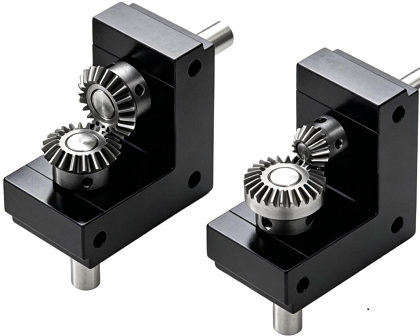
Gears also provide straightforward ways to change shaft direction. A bevel gear pair can transmit motion between intersecting shafts, making a 90-degree change of axis possible within a relatively small envelope.
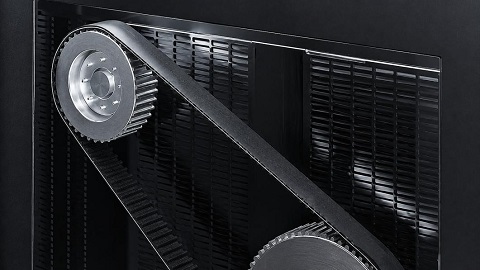
Belts and chains become more attractive when the shafts are farther apart. A synchronous belt can bridge a substantial center distance without adding an intermediate gear train, while also allowing considerable freedom in component placement. Chain drives offer similar flexibility when a positive mechanical drive is required over a larger distance.
So the first design question is simple:
Does the transmission need to be compact and integrated, or does it need to connect components that are naturally separated?
How Important Are Positioning and Repeatability?
This comparison is often oversimplified.
It is easy to describe gears as precise, belts as flexible, and chains as loose. In reality, positioning behavior depends on the entire transmission.
A conventional gear mesh normally requires some backlash. The amount of lost motion reaching the output also depends on gear accuracy, center distance, bearings, shaft stiffness, housing stiffness, and whether backlash compensation is used.
Gears can provide high torsional stiffness, but using gears does not automatically create a zero-backlash axis.
Synchronous belts work differently. Their teeth positively engage the pulley rather than relying on friction to maintain the transmission ratio. However, positioning error can still come from belt elongation, tooth-to-groove clearance, and tooth deformation under load.
Chain drives introduce another set of variables. Joint clearance, sprocket engagement, chain wear, and changing slack can affect motion as the drive accumulates operating hours.
For a servo axis, indexing mechanism, or reversing motion system, a more useful question is:
How much lost motion and elastic deflection can the complete drive tolerate under actual torque?
That is more meaningful than judging accuracy by component type alone.
When Do Gears Make the Most Sense?
A gear drive becomes increasingly attractive when several requirements occur together.
Compact Packaging
A gear train can place the input and output close together and transmit substantial torque without reserving space for a long belt or chain span.
This makes gears well suited to compact rotary mechanisms, indexing equipment, gearboxes, and enclosed machine modules.
A Change in Shaft Direction
Bevel gearing is particularly useful when power must turn through 90 degrees. The direction change can be incorporated directly into the transmission instead of adding additional shafts, pulleys, or routing components.
This can simplify the mechanical layout when space around the driven component is limited.
High Torsional Stiffness
When changing torque should produce as little angular displacement as practical, a relatively stiff gear train can be advantageous.
Backlash still needs to be managed, but there is no long flexible transmission member between the shafts.
High Load in a Limited Envelope
Belts and chains can also transmit substantial loads when correctly sized. The advantage of gearing is often not simply maximum load capacity, but how much transmission capability can be packaged into the available space.
If increasing pulley diameter, belt width, chain size, or center distance makes the machine too large, a gear solution deserves closer consideration.
Speed and Load Alone Should Not Decide the Drive
“High speed” or “high load” is not enough information to select gears, belts, or chains.
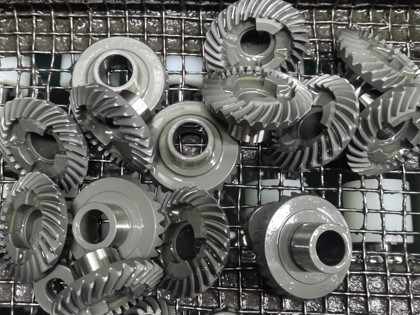
Modern synchronous belts can operate at considerable speeds and transmit substantial power. Chains can handle demanding mechanical loads where rugged positive engagement is useful. Gear capability varies equally widely depending on tooth geometry, material, heat treatment, accuracy, lubrication, bearings, and operating temperature.
The machine designer therefore needs to look beyond nominal torque.
Questions that often matter more include:
- How frequently does the drive reverse?
- Is the load steady or cyclic?
- How much compliance can the motion tolerate?
- How large can the pulleys, sprockets, or gears become?
- Will temperature or contamination affect the drive?
- How easily can the transmission be inspected?
A drive that looks adequate from a basic power calculation may behave very differently once these factors are considered.
What About Shock Loads?
Shock loading can change an otherwise obvious choice.
A belt introduces some compliance between the driving and driven members. Depending on belt construction and tension, that compliance can soften the way a transient load travels through the transmission.
A gear drive behaves more rigidly. Sudden changes in torque are transmitted more directly through the teeth, shafts, bearings, and housing. That may be desirable for motion control, but impact loads need to be considered during gear and support-structure design.
Chains are mechanically robust, but shock loading still affects their selection. Sudden acceleration, impact, or fluctuating loads can increase forces in the chain and sprocket system and may require additional design margin.
Where jams, impacts, or abrupt starts are normal rather than exceptional, the transmission should therefore be selected around those events rather than only around steady-state torque.
Maintenance Access May Be the Deciding Factor
A transmission that is easy to install is not necessarily easy to maintain.
An enclosed gear drive protects the gearing from external contamination and can keep lubricant contained. However, internal gears may require more machine disassembly if inspection or replacement is eventually needed.
A synchronous belt normally requires no lubrication. Belt condition, alignment, and tension still need attention, but an external belt drive can often be inspected quickly.
Roller chains generally require more attention to lubrication, wear, alignment, and slack. Lubrication at the pin-and-bushing interface is particularly important because wear at this joint contributes to gradual chain elongation.
This makes maintenance access part of the initial machine-layout decision rather than an issue to consider after the machine has been built.
Cleanliness Can Shift the Choice
Lubrication requirements matter very differently from one automation system to another.
A synchronous belt is attractive where lubricant around the transmission is undesirable. This can be useful in packaging, laboratory equipment, and other relatively clean automation environments.
An exposed roller chain normally requires lubrication, making contamination control more important.
Gears usually require lubrication as well, but they can be enclosed inside a sealed housing. This changes the comparison from simply “lubricated versus lubrication-free” to three different situations:
exposed lubrication, contained lubrication, or no lubrication at all.
That distinction is often more relevant to the machine designer.
When Is a Belt or Chain the Better Choice?
Replacing every belt or chain with gears would not make every automation system better.
A synchronous belt is often attractive when:
- the shafts are relatively far apart;
- quiet operation is important;
- lubrication should be avoided;
- lower rotating mass is useful;
- some compliance is acceptable;
- the drive needs to remain easily accessible.
A roller chain may make more sense when:
- a longer center distance must be bridged;
- the environment is mechanically demanding;
- positive engagement is required;
- periodic lubrication and adjustment are acceptable;
- very tight positioning is not the dominant requirement.
Gears become especially attractive when compact packaging, stiffness, shaft orientation, and load density need to be solved at the same time.
A Practical Comparison
| Design Requirement | Gears | Synchronous Belts | Roller Chains |
| Compact transmission | Strong | Moderate | Moderate |
| Long center distance | Limited | Strong | Strong |
| 90° shaft arrangement | Strong | Application-dependent | Limited |
| Torsional stiffness | Strong | Moderate | Moderate |
| Low noise | Design-dependent | Strong | Generally weaker |
| No exposed lubricant | Possible when enclosed | Strong | Generally weaker |
| Shock compliance | Lower | Higher | Moderate |
| External service access | Application-dependent | Strong | Strong |
No table can select the drive by itself. Gear type, belt construction, chain size, ratio, load cycle, installation, and operating environment can all change the result.
Choose the Transmission Around the Machine
The best transmission is the one that creates the fewest compromises for the complete automation system.
Use gears when the drive must be compact and stiff, when shaft direction needs to change within a limited envelope, or when substantial torque must be integrated closely with the mechanism.
Use a synchronous belt when center distance, quiet operation, cleanliness, access, or some transmission compliance matters more.
Use a chain when a rugged positive drive must span a larger distance and the machine can accommodate lubrication, slack control, and periodic maintenance.
Most importantly, compare the options under real operating conditions. Direction reversals, transient loads, frame stiffness, contamination, maintenance access, and positioning under torque can expose differences that do not appear in a basic power calculation.
There is rarely one universally better transmission. There is only the transmission that better fits the machine.
This is a guest post from PairGears: https://www.pairgears.com/
Author Bio
Feng Liu is the CEO of PairGears, a precision gear and shaft manufacturer. His work focuses on manufacturability, gear quality control, and practical power-transmission considerations in custom gear projects.


Electrical Engineer and business owner from the Nashville, Tennessee area. I also play music, Chess and Go.